
Elysian Laser Aesthetics
SE Calgary, Sunpark Plaza
Owner & Operator: Alaina
Service: IPL Photofacial (Intense Pulsed Light)
Device: IPL handpiece on the Quanta EVO
Serving: Calgary, Douglasdale, Mahogany, Auburn Bay, McKenzie Towne, Cranston, Seton, Chaparral
Service page: IPL photofacial Calgary
Book Online
IPL Photofacial Guide: What to Expect, Who It’s For, and Why You Might Only Need One Session
Quick Answer: This IPL photofacial guide covers what IPL treats, who it suits, how healing goes, and what it costs. An IPL photofacial uses broad-spectrum light to treat sun damage, brown spots, redness, and uneven tone. Most clients see dramatic improvement in one to three sessions. Minimal downtime, no injections, and you pay for one session at a time.
An IPL photofacial in Calgary is one of the most effective ways to reset sun-damaged, uneven skin. I wrote this IPL photofacial guide from my own practice, where I price every session individually and only recommend what your skin needs. Most clients genuinely see the results they came for in one to three sessions, and I’ll always be straight with you about what’s realistic before you book a thing.
Here’s everything you need to know.
What Is an IPL Photofacial?
IPL stands for Intense Pulsed Light. Unlike a single-wavelength laser, IPL delivers a broad spectrum of light energy into the skin. Different wavelengths target different chromophores: the pigment in brown spots and the haemoglobin in redness. That breaks them down so the body can clear them naturally.
At Elysian, I use the Quanta EVO platform for IPL treatments. It’s a professional-grade device with precise energy control, which matters a great deal for safety and consistency of results.
IPL is not a laser in the traditional sense. It doesn’t create controlled injury the way fractional CO2 does. That’s actually its advantage for certain concerns: it treats selectively without disrupting the skin surface, which means minimal downtime.
What Skin Concerns Does IPL Treat Best?
Sun Damage and Brown Spots
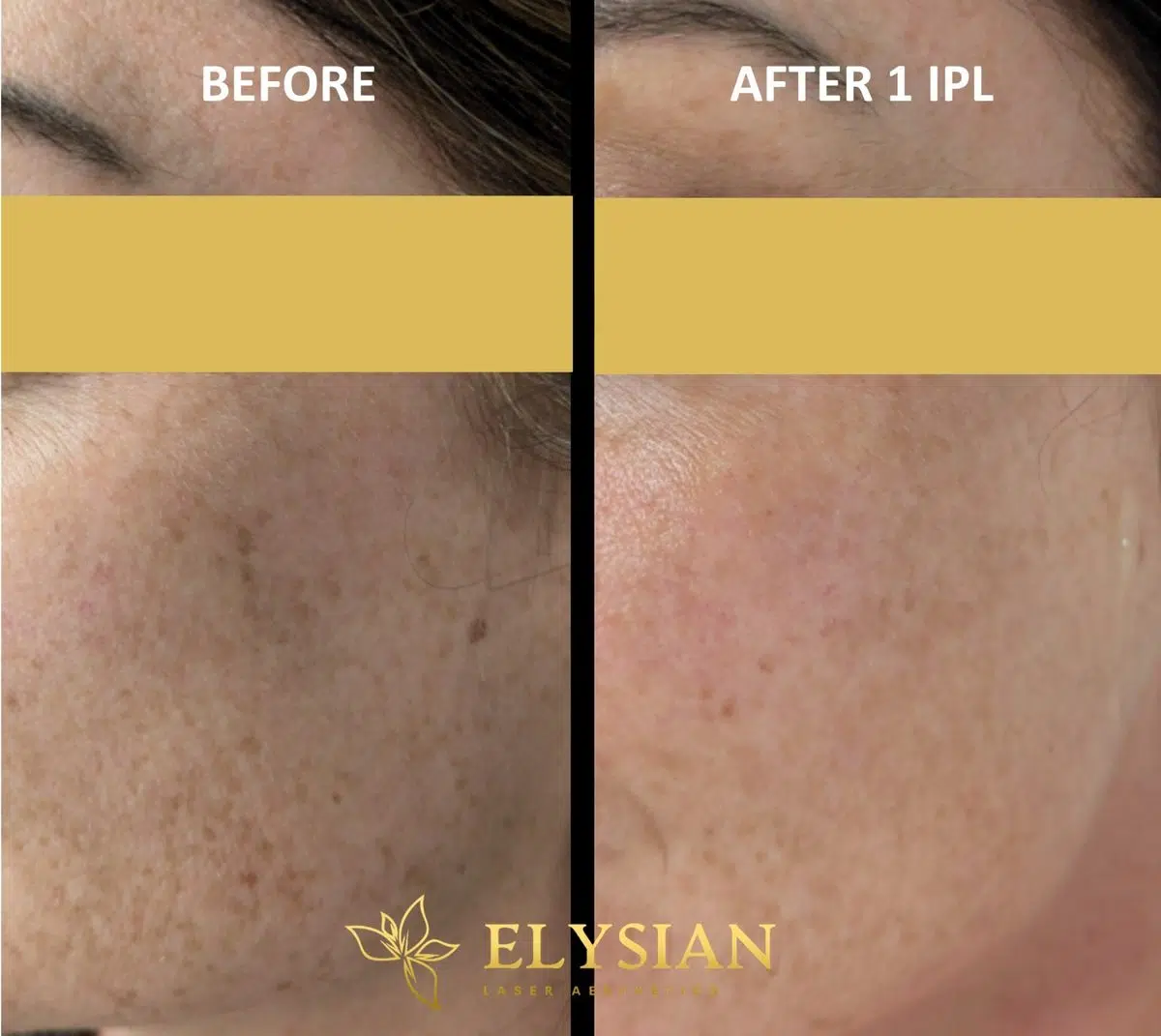
This is where IPL genuinely shines. Years of Calgary sun exposure, including UV reflected off snow, accumulates as flat brown spots, freckling, and general dullness. IPL targets the melanin in those spots directly. In the days following treatment, the spots typically darken and then flake away, revealing clearer skin underneath.
Redness and Rosacea
IPL’s longer wavelengths target haemoglobin in visible blood vessels and diffuse redness. For clients with rosacea or persistent facial flushing, IPL can produce a significant, visible reduction in background redness. The Canadian Dermatology Association recognizes IPL as one of the standard approaches for managing the vascular component of rosacea.
Uneven Skin Tone and Dullness
Many clients come in for one specific concern and days later are remarking that their overall complexion looks brighter and more even. IPL has a toning effect across the full treatment area that goes beyond just the targeted spots.
What IPL Does Not Treat
IPL is not the right tool for deeper wrinkles, significant skin laxity, or texture issues caused by enlarged pores or acne. For those concerns, fractional CO2 resurfacing is the more appropriate option. You can read more about the difference on my CO2 laser Calgary page.
Am I a Good Candidate for IPL in Calgary?
IPL works by targeting the contrast between pigment or vessels and the surrounding skin. That contrast depends on your skin tone and, critically, your tan level at the time of treatment.
Ideal candidates:
- Fitzpatrick skin types I–III (fair to medium skin)
- No active tan of any kind, including spray tan, self-tanner, or recent sun exposure
- Concerns including brown spots, sun damage, redness, rosacea, or uneven tone
- Not currently pregnant
- Not on photosensitizing medications (discuss your full medication list at consultation)
I need to be very direct about this: any tan is a contraindication for IPL at my clinic, full stop. A tan reduces the contrast between the target and the surrounding skin, which increases the risk of unwanted side effects (burns). I won’t treat tanned skin, regardless of how light the tan appears. SPF50+ daily is mandatory prior to IPL, or Mineral SPF 40+. If you’ve been in the sun, especially without sunscreen, I’ll always recommend rescheduling.
If you have a deeper skin tone or are unsure whether IPL is right for your skin, book a consultation first. There’s no obligation, and I’d rather spend 15 minutes making sure IPL is actually the right treatment for you than book you into something that won’t deliver.
Why Do Most of My Clients Need Only 1–3 Sessions?
Most clinics sell IPL in packages of three to six sessions. I understand the business rationale, but I don’t think it’s honest, and I’m not willing to sell you treatments you likely won’t need.
In my experience, one well-delivered IPL session makes a visible difference to sun damage and redness for most clients. Research comparing IPL with 532 nm and 595 nm vascular lasers found that all three reduce visible blood vessels, because IPL can be filtered to target the same colors those lasers do.
After your first session, I’ll give you an honest read on what’s been achieved and what, if anything, a second session could add. Some clients with more extensive sun damage do benefit from a second session spaced four to six weeks later. Some clients are done after one. I’ll tell you which category you’re likely in.
What Does an IPL Photofacial Feel Like?
The most common description is a quick, mild rubber-band snap with a flash of light with each pulse, followed by a mild warming sensation. The treatment itself typically takes 20 minutes for a full face.
I apply a cool ultrasound gel to the skin before treatment, which helps with comfort and light transmission. Most clients find the sensation very tolerable. The cheekbones and nose, where spots are often densest, tend to be the most sensitive areas.
No topical numbing cream is required or typically used for IPL.
What Should I Expect After an IPL Treatment?
Days 1–3
The skin may look slightly red and feel mildly warm, similar to a mild sunburn. Brown spots will often look darker immediately after treatment. This is completely expected and is a sign the treatment is working. The darkening is the pigment rising to the surface before it flakes away.
Days 4–10
The darkened spots will begin to flake off naturally. Do not pick or scrub them. Let them shed on their own timeline. Redness typically settles within 24–48 hours.
For moisturizing, I recommend a lightweight, gentle moisturizer you already have at home is almost always fine. There’s no need for anything special. Keep the area clean and avoid active exfoliants, retinoids, or acids until the skin has fully settled, likely one week.
Week 2 and Beyond
By two weeks post-treatment, most clients are seeing the cleared skin underneath where the spots were. The full result continues to improve over four to six weeks as the body clears the treated pigment and vessels.
Sun protection is non-negotiable after IPL. Use a mineral SPF 30 or higher daily, and avoid deliberate sun exposure for at least four weeks.
How Much Does IPL Cost in Calgary?
IPL pricing in Calgary varies significantly depending on the clinic, device, and treatment area. At my clinic, a full-face IPL photofacial is $270 + GST for your first session and $250 + GST for any session after that. Every price is listed on my laser pricing page, and my IPL photofacial Calgary page covers the treatment itself.
How Does IPL Compare to CO2 Laser?
These two treatments are often considered together, but they address different things.
IPL is the right first step when the primary concern is pigmentation, redness, sun damage, and tone, with minimal disruption to the skin surface and essentially no downtime. It does not trigger collagen production, however, or tighten skin.
Fractional CO2 resurfacing is the appropriate choice when the concern is texture, lines, skin laxity, deeper resurfacing, or issues that require controlled remodelling of the dermis.
Some clients benefit from both over time, starting with IPL to clear pigment, then considering CO2 for deeper resurfacing work. I’ll always discuss realistic sequencing with you at consultation. You can also read more in my post on CO2 laser vs. microneedling in Calgary to understand where CO2 fits relative to other approaches.
How Do I Prepare for an IPL Photofacial in Calgary?
- Avoid sun exposure and tanning (including self-tanner) for at least six weeks before treatment
- Discontinue retinoids and active exfoliants (glycolic, salicylic acid) for five to seven days prior
- Arrive with clean, makeup-free skin on the day of treatment. Clear or white moisturizer is fine.
- Disclose all current medications at consultation, because some antibiotics and supplements increase photosensitivity
- Avoid waxing, facials dermal rolling, microneedling or other treatments on the area in the week before
IPL Photofacial Guide: Frequently Asked Questions
Is IPL the same as a laser?
No. A laser emits a single wavelength of light, while IPL emits a broad spectrum that is filtered to target pigment and redness. At my clinic, IPL is a separate handpiece on my Quanta EVO, the same platform I use for laser hair removal.
How many IPL sessions will I need in Calgary?
Most clients at Elysian see the results they came for in one to three IPL sessions. I price each session individually because most clients don’t need more. After your first session, I’ll give you an honest assessment of whether a second session would add meaningful improvement.
What is the best time of year to get IPL in Calgary?
Fall and winter are ideal. UV exposure is lower, sun avoidance is easier, and you have more time to let results develop before summer. That said, IPL can be performed year-round as long as you are not tanned and can commit to strict sun protection afterward.
Can I get IPL if I have a tan from Calgary’s sunny summers?
No. Any tan, including a light summer base tan, is a contraindication for IPL at my clinic. I’ll always ask you to wait until your tan has fully faded before proceeding. This is a safety rule, not an upsell strategy.
Is IPL covered by Alberta Health Services or insurance?
IPL is a cosmetic procedure and is not covered by AHS or most private insurance plans. Pricing at Elysian is listed transparently on the pricing page.
Is a photofacial the same thing as IPL?
Yes. “Photofacial” is the common name for an IPL treatment on the face. You may also see it called a fotofacial or photorejuvenation. If you want to book, you can do that online.
Does IPL hurt?
Most clients describe IPL as a quick snap sensation, similar to a rubber band, with a mild warmth after each pulse. It’s well-tolerated without numbing cream. The nose and cheekbones tend to be the most sensitive areas.
How long does an IPL photofacial take?
A full face IPL treatment typically takes 20 to 30 minutes. You can return to your normal day immediately after, though your skin may look mildly flushed for a few hours.
Ready to Book an IPL Photofacial in Calgary?
If you’re dealing with sun damage, brown spots, redness, or an uneven complexion, IPL may be exactly what you’re looking for, and you likely won’t need six sessions to see it.
I’m Alaina, and I operate Elysian Laser Aesthetics as a solo practice in SE Calgary. Every treatment I offer, I do myself. If anything in this IPL photofacial guide raised a question about your own skin, I’m happy to talk it through before you book.
or use the contact form to ask a question first.