
CO2 Laser Recovery Day by Day: Real Photos and an Honest Deka Tetra Timeline
Quick answer: Deka Tetra CO2 recovery is faster than older fractional CO2 devices because its Pulse Shape Design technology delivers ablation with less residual thermal damage. Clients typically look only pink by days 6-7, with shedding beginning days 5-6.
This post is written by Alaina, owner and sole practitioner of Elysian Laser Aesthetics — a solo laser clinic at 15 Sunpark Plaza SE in Sunpark, Calgary. I use the Deka Tetra fractional CO2 laser in my practice, so the day-by-day observations here reflect what I see in my Calgary clients. But the faster recovery isn’t something I can take credit for — it’s the device itself. Any clinic running the Deka Tetra should be seeing similar timelines. If you’re shopping for CO2 anywhere in Calgary, the most important question to ask isn’t “how good is this clinic” — it’s “what device do you use.”
deka tetra co2 recovery timeline
Why Generic CO2 Laser Recovery Guides Don’t Describe the Deka Tetra
Most of what you’ll read online about CO2 laser recovery time — “two weeks of downtime,” “oozing and crusting for 10 days,” — is based on older fractional CO2 platforms. Those articles aren’t wrong for the devices they describe. They just don’t describe the Deka Tetra.
The Deka Tetra is a newer-generation fractional CO2 platform manufactured by DEKA in Italy, using what’s called Pulse Shape Design (PSD) technology. Without getting too technical, PSD delivers the ablation (the controlled tissue removal that drives collagen remodeling) with far less residual thermal damage to surrounding skin. Less collateral thermal damage means less inflammation, less oozing, less crusting, and a compressed visible recovery timeline. It delivers the pulse in a zigzag pattern instead of the typical vertical columns.
This isn’t marketing spin and it isn’t clinic-specific. It’s what the device’s pulse technology is designed to do, and it’s consistent across the Deka Tetra installed base — including the unit I use at my Calgary clinic.
How Long Does a Deka Tetra CO2 Treatment Actually Take?
A full face Deka Tetra treatment typically takes 8-10 minutes of actual laser time. Add 45 minutes of medical-grade topical numbing beforehand and pre-treatment prep, and you’re in and out in about 1.5 hours total.
That’s notably faster than traditional fractional CO2, which typically runs 20-30 minutes for a full-face pass on older platforms. Clients who’ve had CO2 elsewhere often mention how much faster the Deka Tetra treatment feels. Shorter treatment time matters for recovery because less time under the laser generally correlates with less overall thermal load on the skin.
What About Pain During and After a Deka Tetra CO2 Treatment?
I apply a medical-grade topical numbing cream for 45 minutes before any Deka Tetra treatment, which makes the procedure itself very manageable for most clients. You feel heat and a tingling sensation during the laser pass, not sharp pain.
After the treatment, most clients describe a stinging, sunburn-like sensation that lasts 1-2 hours at the deepest settings, then gradually settles. Clients on lighter settings often feel comfortable within less time.
Compare that to what industry-standard CO2 recovery descriptions routinely mention for older devices: burning or stinging sensations that persist into days one and two, sometimes requiring prescribed pain medication. I’ve never needed to prescribe anything beyond topical aftercare for a Deka Tetra client. Again — that’s the device doing that, not me.
What Does a Real Deka Tetra CO2 Recovery Timeline Look Like?
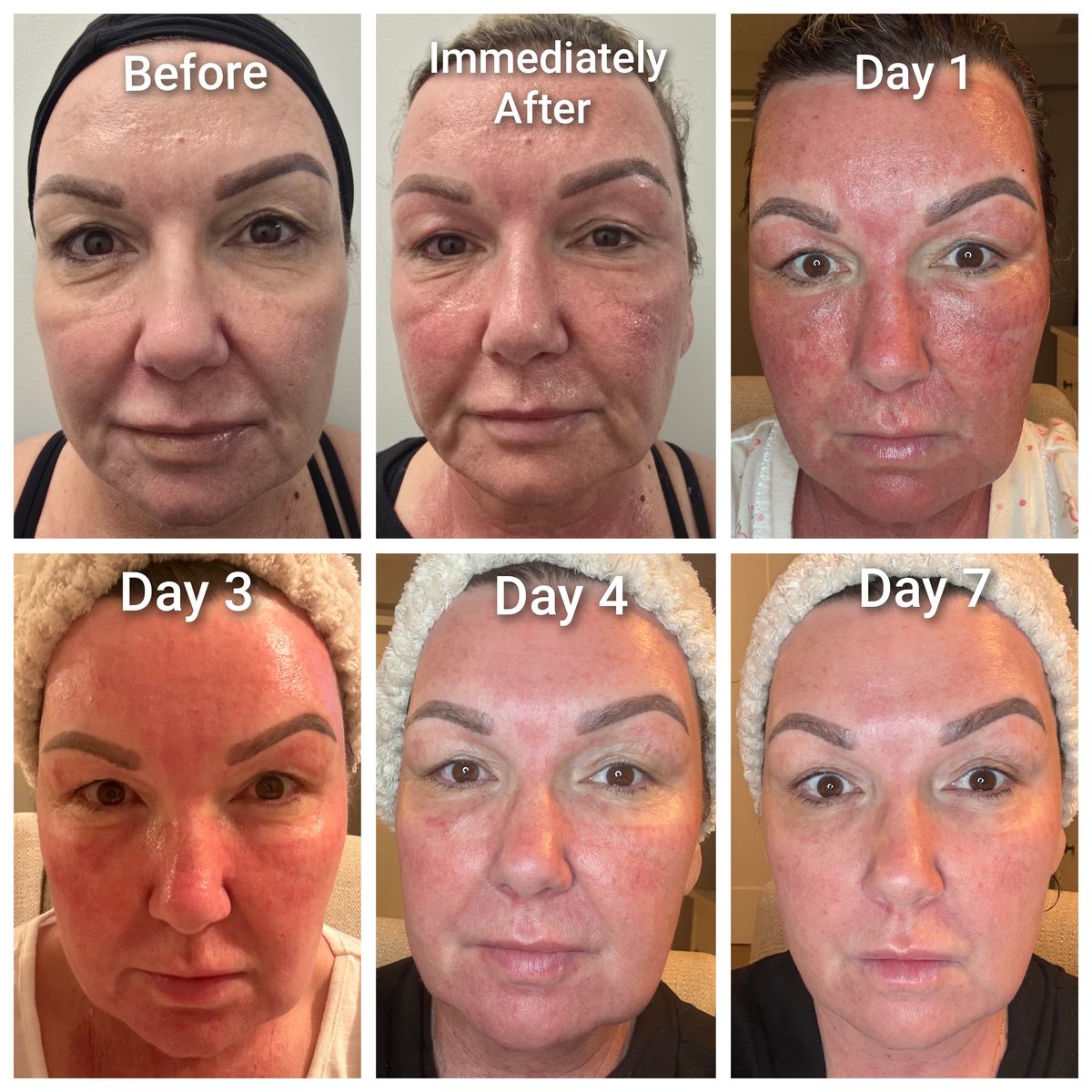
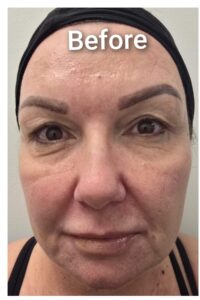
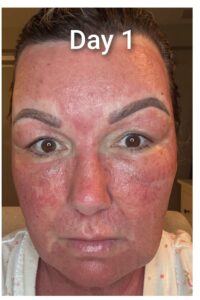
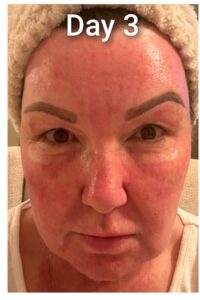
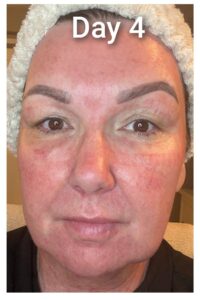
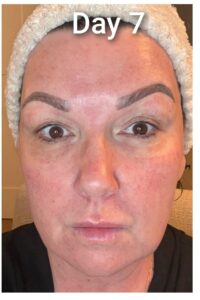
Here’s the day-by-day reality based on what I see most consistently in my Calgary practice. Individual healing varies — age, skin type, general health, and treatment depth all affect the timeline — but this is the pattern I see most often. The photos below are from a real client treated with the Deka Tetra, used with her permission.
Day 0 — Immediately After Treatment
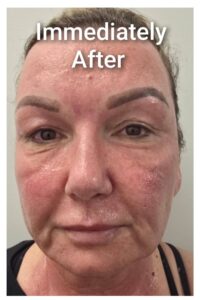
Skin is red and warm, similar to a strong sunburn. There’s usually minimal pinpoint bleeding and oozing thanks to the Deka Tetra’s tighter cautery — most clients don’t ooze the way they might expect based on what they’ve read about older CO2 devices. The client goes home with barrier balm and written aftercare instructions.
Day 1 — Red and Swollen, Settling
Face looks red and feels tight. Mild swelling is normal, particularly around the eyes if I treated the periorbital area. Most clients are surprised by how little oozing there is compared to what they’d been warned about. They’re resting, keeping the skin clean, and applying the heavy barrier balm I recommend often — always tallow-based or shea butter-based or Cicaplast B5 Baume.
Day 3 — Bronzed and Tight (The Quiet Phase)
Skin darkens to a bronzed appearance as the treated tissue prepares to shed. It feels tight and slightly rough. No peeling yet — this is the quiet phase before shedding begins. Clients sometimes panic here thinking something is wrong because the skin looks worse than Day 1. It isn’t — this is exactly what the Deka Tetra recovery looks like at this stage, and what comes next is the shedding phase.
Day 4 — Transitioning Toward Shedding
The bronzed layer starts to soften and look patchy as the natural shedding process prepares to begin. Still not time for any mechanical exfoliation — skin needs another day or two to fully close before anything touches it. Continue gentle cleansing and barrier balm.
Days 5-6 — Gentle Shedding Begins
This is where the Deka Tetra’s timeline diverges most noticeably from what you’ll read in generic CO2 recovery guides. Most clients begin gentle shedding at days 5-6, not week two like older fractional CO2 devices. The bronzed surface layer starts releasing, and clients can begin very gentle mechanical exfoliation with a soft loofah to help the dead skin along.
Important: gentle means gentle. Never aggressive scrubbing. The goal is to assist the natural shedding process, not force it.
At this time, most clients can start using a mineral sunscreen and begin short trips outdoors during daylight.
Day 7 — Typically Pink but Decently Presentable
By the end of the first week, most clients are pink rather than red, with fresh skin fully exposed underneath. Mineral makeup covers the pinkness easily, and most people are comfortable returning to work and social activities. Residual pinkness continues to fade over the following 1-2 weeks. Collagen remodeling continues internally for 3-6 months after treatment — the visible result at two weeks is not the final result. Daily mineral sunscreen and prolonged sun avoidance is mandatory for 2 weeks.
Why Is Deka Tetra CO2 Recovery Faster Than Other Fractional CO2 Lasers?
The short answer is pulse technology. The longer answer involves how different CO2 platforms deliver thermal energy to skin.
Older fractional CO2 devices deliver energy with longer pulse durations. This produces the ablation you want with fractional pulses deep into the skin, but it also leaves behind more residual thermal damage — heat that spreads into surrounding tissue. More collateral thermal damage means more inflammation, more time for the skin to repair that thermal injury, and a longer visible recovery. Here’s the physical reason behind the faster healing: every fractional CO2 column has two parts — the ablation itself, and a ring of thermal damage (a “halo”) around each column where heat spread from the laser pulse. Older CO2 devices create wider halos, which means more surface damage to heal. The Deka Tetra produces tighter, smaller halos around each column — same ablation depth reaching the dermis, significantly less collateral thermal damage at the surface. Less surface damage to repair is why skin shedding begins days 5-6 rather than week 2.
The Deka Tetra’s PSD technology offers precise control over pulse shape (zigzag patterns), letting the operator deliver the same depth of ablation with significantly less residual thermal effect. It also leaves smaller zones of injury at the surface which heal much faster than older CO2 technology. Same collagen remodeling benefit, less collateral damage, faster healing. Published clinical reviews of fractional ablative CO2 consistently confirm that outcomes improve with better energy control — the devices with finer pulse modulation produce results comparable to traditional fractional CO2 with meaningfully shorter recovery windows.
How to Tell If Your Calgary CO2 Clinic Uses a Faster-Healing Device
If you’re shopping for CO2 in Calgary, ask these questions before you book:
- What is the exact make and model of CO2 laser? Not just “CO2 laser” — the specific device. Deka Tetra, SmartXide, Fraxel Re:pair, Ultrapulse, etc. are all different platforms with different recovery profiles.
- How long does a full-face treatment take? Deka Tetra should be 8-15 minutes. Older platforms run longer.
- How much oozing and crusting should I expect? The answer should match what you see in the device manufacturer’s published recovery timeline — not a generic CO2 description.
- When do most clients begin gentle exfoliation? Deka Tetra: days 5-6. Older CO2: typically week 2+.
- Can I see real before-and-after photos of recovery from your clinic? Any clinic comfortable with their device should be able to show you.
The device your provider uses is the single biggest variable in your recovery. Clinician skill matters for safety and settings, but the raw physics of the recovery timeline comes from the laser itself.
How Long Should I Plan to Stay Home After Deka Tetra CO2 Laser?
For most Deka Tetra CO2 clients, planning a full week away from work and in-person social obligations is the honest recommendation. Some clients return to video calls by day 4-5 and to the office by day 6-7.
If you live in Mahogany, Auburn Bay, Cranston, Seton, Sundance, Bonavista or elsewhere in Calgary and have a flexible work-from-home setup or some time off work, scheduling is straightforward. Clients often book their treatment on a Monday and are back on camera by Friday. For clients commuting into downtown Calgary offices, taking at least a full week off and scheduling the treatment on a Thursday or Friday works well so the worst of the visible healing happens over the weekend.
Is Faster Deka Tetra CO2 Recovery Too Good to Be True?
Fair skepticism. Here’s the honest framing:
The Deka Tetra doesn’t eliminate recovery — nothing genuinely does if the treatment is actually doing what it’s supposed to do. If a CO2 treatment truly produces no downtime, it’s almost certainly a very surface-level treatment (like CoolPeel), which serves a different purpose and doesn’t deliver the collagen remodeling that deeper CO2 provides.
What the Deka Tetra offers is a more efficient version of the same deep CO2 benefit. You still need about a week to look presentable. You still have real healing to do. But you don’t have the extended weeks of residual redness that some older platforms leave behind, and you’re shedding and recovering on a compressed timeline.
If you want the benefits of deep fractional CO2 — serious collagen remodeling, real texture and tone improvement, meaningful reduction in lines — with the shortest honest recovery currently possible, that’s what this device was designed for.
Deka Tetra CO2 Recovery vs. Older Fractional CO2 Devices: Side-by-Side
| Recovery Milestone | Older Fractional CO2 Devices | Deka Tetra CO2 |
|---|---|---|
| Treatment time (full face) | 20-30 minutes typical | 8-10 minutes typical |
| Post-treatment stinging | Can last 24-48 hours | Up to 2 hours at deepest settings |
| Oozing and pinpoint bleeding | Common days 1-3 | Minimal (more cautery) |
| Shedding begins | Week 2+ typical | Days 5-6 typical |
| Pink rather than red | 3-4 weeks, sometimes 8-10 weeks | Days 6-7 for most clients |
| Back to office work | 10-14 days | 6-7 days typical |
How Do I Get the Best Deka Tetra CO2 Recovery?
Whatever device you’re treated with, aftercare compliance is the single biggest variable in outcome. Specifically:
- Use a heavy barrier balm — tallow-based or shea butter-based, never petroleum-based. See my full CO2 aftercare guide for current product recommendations.
- Do not pick, scrub, or attempt to peel anything in the first four days. The skin needs to close before any mechanical contact.
- Starting days 5-6, introduce gentle mechanical exfoliation with a soft loofah as shedding begins. Gentle only.
- Stay out of direct sun. Calgary’s high-altitude UV is serious even when it’s cloudy.
- Sleep slightly elevated for the first 2-3 nights to reduce swelling.
- Avoid actives (retinoids, AHAs, BHAs, Vitamin C) for at least 4 weeks post-treatment.
- Don’t smoke, and minimize alcohol for the first week. Both impair collagen production.
Why Does Calgary’s Climate Affect CO2 Laser Recovery Day by Day?
Calgary presents challenges for CO2 laser recovery day by day that clinics in humid climates never have to think about.
Dry winter air. Indoor humidity here sits around 40-50% with forced air heating. Healing skin needs constant moisture, so hydration matters more in Calgary than it would on the coast.
Chinook swings. I can get 20-degree temperature changes within hours. Those pressure and humidity shifts affect healing skin, which is another reason to stay indoors through the first few days.
Altitude UV. Calgary sits above 1,000 metres, so UV radiation is stronger here than at sea level. Even in winter, UV on healing skin can cause hyperpigmentation.
What Does CO2 Laser Healing Look Like on Day 5?
Day 5 is the turn. On the Deka Tetra this is usually when shedding starts, the bronzed and tight surface begins flaking away, and you can see new skin underneath. It looks worse in the mirror than it is, and it is the stage clients text me about most.
This is also when gentle mechanical exfoliation becomes appropriate. A soft scrubber or loofah, no pressure, working with the shedding rather than forcing it. Before day 5, leave it alone.
By day 6 most people are presentable with mineral makeup, and day 6 or 7 is a realistic return to in-office work.
Red Flags During CO2 Laser Recovery: When to Contact Me
Complications are rare when protocols are followed. Contact me straight away if you notice:
- Severe pain, burning or stinging after the first 12 hours
- Signs of infection such as increasing redness, warmth, swelling or oozing after the first day or two
- Yellow or green discharge past the first day
- Fever or chills
- A cold sore outbreak
- Unusual bleeding after the first day
- Anything at all about your healing that is worrying you
That last one is not filler. I check in with every CO2 client daily through the first week, I look at your healing photos, and you can text me as many times as you want.
Why Is Fall and Winter the Best Time for CO2 Laser Recovery in Calgary?
Healing skin is highly sensitive to UV, and UV on fresh skin is what causes hyperpigmentation. Calgary’s shorter days and indoor months make sun avoidance realistic in a way that July never does.
There is a practical bonus too. Start your CO2 laser recovery day by day through fall and your results are settled and fully healed by the time summer comes around.
Frequently Asked Questions About Deka Tetra CO2 Recovery
How long does Deka Tetra CO2 recovery take?
Most clients treated with the Deka Tetra are pink rather than red by days 6-7 and comfortable returning to work and social activities by the end of week one. Shedding typically begins days 5-6. Residual pinkness continues to fade over the following few weeks.
Is the Deka Tetra CO2 recovery really faster than other fractional CO2 lasers?
Yes, and the reason is pulse technology. The Deka Tetra’s Pulse Shape Design delivers ablation with less residual thermal damage to surrounding skin than older fractional CO2 platforms, which compresses the visible recovery window. This is a device-level difference, not a clinic-level one — any provider using the Deka Tetra should see similar timelines.
How soon can I return to work after a Deka Tetra CO2 treatment?
Most clients return to in-office work around day 6-7, covering residual pinkness with mineral makeup. If you work from home, you may be back on video calls by day 4-5. Plan a full week of flexibility regardless.
Why do generic CO2 recovery guides describe slower healing than what I’m reading here?
Most online CO2 recovery guides describe older fractional CO2 devices that produce more residual thermal damage than the Deka Tetra. Their timelines are accurate for those platforms — they just don’t describe the newer-generation device. When reading CO2 recovery information online, check whether the article specifies what device it’s based on.
Does every CO2 laser clinic in Calgary use the Deka Tetra?
No. Calgary clinics use a range of CO2 platforms, and recovery timelines vary accordingly. Before booking a CO2 treatment anywhere, ask specifically what device is used. The Deka Tetra is one of several newer-generation platforms with faster recovery profiles; older Fraxel, Ultrapulse, and similar devices will produce longer recovery timelines regardless of clinician skill.
Do I need multiple Deka Tetra CO2 treatments to see results?
Most clients see meaningful improvement from a single deep Deka Tetra CO2 treatment, with collagen remodeling continuing to improve results over several months. I don’t sell pre-packaged multi-session CO2 protocols — I recommend single treatments and reassess from there, however some clients over 60 may want to consider doing 2 sessions 5-6 months apart for best results.
What’s the difference between CoolPeel and Deka Tetra deep CO2?
Both run on the Deka Tetra platform but use different pulse settings. CoolPeel is a very light surface treatment with 1-3 days of downtime, suitable for fine lines and surface tone but not deep enough for significant collagen remodeling. Deeper CO2 resurfacing targets dermal remodeling and has the 5-7 day visible recovery timeline described in this post. See my detailed comparison for more.
What makes Deka Tetra CO2 recovery different from other fractional CO2 lasers?
Deka Tetra CO2 recovery is compressed by the device’s Pulse Shape Design technology, which delivers the same ablation depth with tighter thermal halos around each column. Less collateral thermal damage at the surface means less inflammation, faster shedding, and a visible recovery timeline that runs roughly a week shorter than older fractional CO2 platforms.
Book a Free Consultation at Elysian Laser in SE Calgary
If you’re considering CO2 laser and want an honest assessment of whether Deka Tetra CO2 recovery timelines would work for your schedule, I offer free consultations at my solo clinic in Sunpark, Calgary. I run the Deka Tetra, so the timeline described in this post is what my clients experience — but more importantly, I’ll give you a straight answer about whether CO2 is the right treatment for your concerns, regardless of which device or which clinic you ultimately choose. I serve clients from across south Calgary including Auburn Bay, Cranston, Mahogany, Seton, Sundance, Evergreen, and surrounding communities.
For current pricing, visit my laser pricing page. For detailed aftercare guidance, see my CO2 laser aftercare tips. If you are planning a second session, read how long to wait between CO2 laser treatments before you rebook. Ready to book? Contact me through elysianlaser.ca.