

Halo vs CO2 laser comes down to depth: Halo is a hybrid laser that pairs a light erbium surface pass with non-ablative heat, while a deep fractional CO2 laser like my Deka Tetra sends ablative columns into the dermis. I’m Alaina, owner-operator of Elysian Laser Aesthetics in SE Calgary, and I treat with the Deka Tetra CO2 every week, so this is the comparison I walk people through at consultations.
Quick answer: Halo vs CO2 laser: Halo suits mild sun damage, tone and pores with a few days of downtime, usually over 1 to 2 sessions. Deep fractional CO2 suits deeper lines, crepey texture and loose skin, with 5 to 10 days of downtime, usually in one session. At my clinic, IPL paired with CoolPeel covers most of what people book Halo for.
Key points for Calgary readers
- Halo combines a 1470 nm non-ablative wavelength with a 2940 nm ablative erbium wavelength in one pass.
- Deep Deka Tetra CO2 is fractional and ablative, with micro-columns that reach the dermis to remodel collagen.
- Calgary pricing I found: Halo full face listed at $1,600 per session at one clinic; my deep Deka Tetra CO2 full face is $1,500 + GST, usually as a single treatment.
- Downtime: Halo is usually a few days of redness and roughness; deep CO2 is 5 to 10 days, with shedding on days 5 to 6 on the Deka Tetra.
- My alternative to Halo is IPL paired with CoolPeel: IPL for brown spots and redness, CoolPeel for surface texture and fine lines, about $870 + GST for a full face of each.
What Is the Difference Between Halo vs CO2 Laser?
The real difference in Halo vs CO2 laser is what each wavelength does to your skin and how deep the ablation goes.
Halo is a hybrid fractional laser made by Sciton. It fires two wavelengths at once. The 1470 nm wavelength heats tissue without removing it, reaching roughly 100 to 700 microns, and the 2940 nm erbium wavelength vaporizes a very shallow layer at the surface, roughly 0 to 100 microns (The Aesthetic Guide). Think of it as a strong surface refresh plus gentle heat underneath.
Fractional CO2 works differently. My Deka Tetra CO2 creates thousands of tiny ablative columns that travel into the dermis, with untouched skin left between each column so you heal from those bridges. Each column has a small ring of heat around it, called a thermal halo. The Deka Tetra keeps those halos tight, which is why my clients heal faster than older CO2 timelines suggest.
Both aim for smoother, more even skin. Halo spreads its effect wide and shallow, while deep CO2 goes narrow and deep, which is where collagen remodeling happens.
How Does Halo vs CO2 Laser Compare Side by Side?
Here is the Halo vs CO2 laser comparison in one table, using published Halo information and my own Deka Tetra protocols.
| Factor | Halo (hybrid) | Deep Deka Tetra CO2 |
|---|---|---|
| Wavelengths | 1470 nm non-ablative + 2940 nm erbium | 10,600 nm CO2, fractional ablative |
| Depth of ablation | Shallow, surface only | Columns into the dermis |
| Best for | Sun damage, uneven tone, pores, early fine lines | Deeper lines, crepey skin, laxity, textural scarring |
| Typical sessions | 1 to 2, about a month apart | Usually 1 |
| Downtime | A few days of redness and roughness | 5 to 10 days; shedding days 5 to 6 |
| Calgary price, full face | $1,600 per session (one clinic’s listed price) | $1,500 + GST at my clinic |
| My Halo alternative | IPL ($270 + GST full face) paired with CoolPeel ($600 + GST full face) for pigment, redness, texture and fine lines | |
Which Has More Downtime, Halo or CO2 Laser?
Deep CO2 has more downtime, and that is the honest trade-off in any Halo vs CO2 laser decision.
After Halo, most clinics describe a few days of redness, swelling and a rough, sandpaper feel as the tiny treated spots flake off. Many people wear makeup the next day.
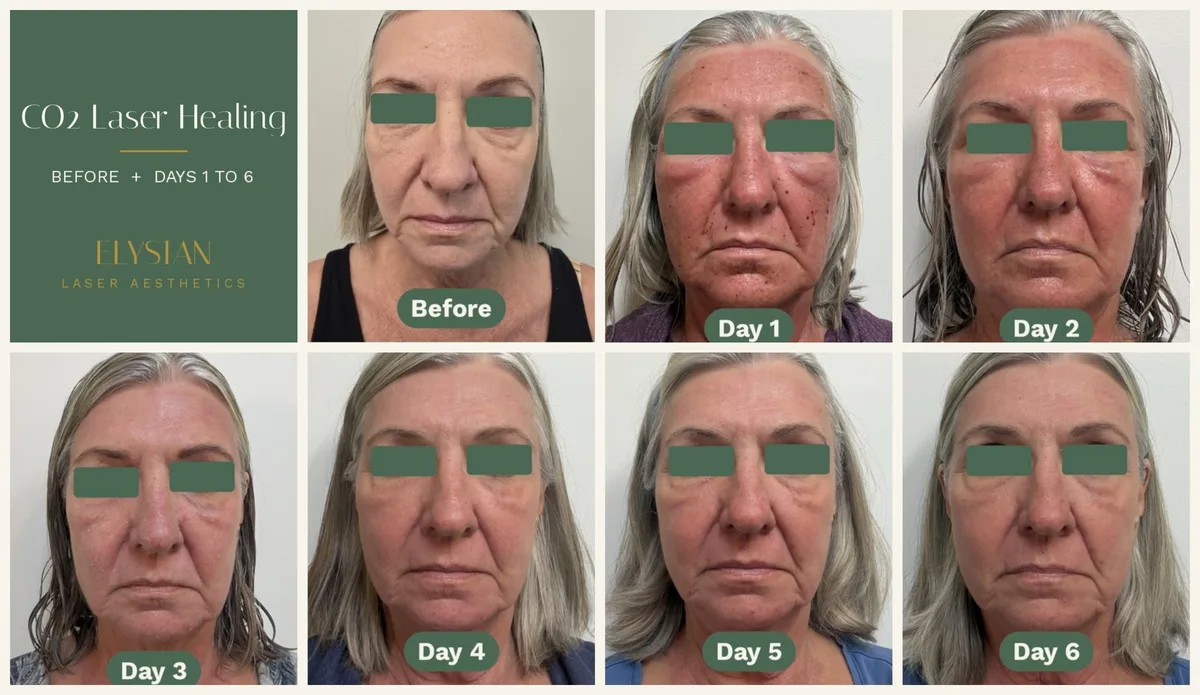
After deep Deka Tetra CO2, plan for 5 to 10 days. Days 1 and 2 are the reddest and most swollen. By day 3 the redness settles a lot, and on the Deka Tetra shedding usually starts on days 5 to 6. Most of my clients are presentable with mineral makeup by around day 6. You can see a real client’s first week in my CO2 recovery day by day post.
You can go back to work any time after CO2, as long as your skin stays clean, out of the sun and free of sweat, and you avoid dusty workplaces until peeling is finished.
How Many Sessions Does Halo vs CO2 Laser Need?
For Halo vs CO2 laser, Halo is usually planned as 1 to 2 treatments and deep CO2 as one.
Published Halo protocols for skin types I to IV describe up to two treatments about a month apart. In a multi-center trial of 29 women who completed two Halo treatments 4 to 6 weeks apart, 80% showed significant improvement on photo analysis (Journal of Drugs in Dermatology, 2018).
With deep Deka Tetra CO2, most clients see meaningful change from a single treatment, and collagen keeps remodeling for months afterward. For clients over 60, a second session 5 to 6 months later can help. I always start with one treatment and reassess once you’ve healed. I don’t pre-sell a series.
How Much Do Halo and CO2 Laser Cost in Calgary?
On cost, Halo vs CO2 laser is closer than most people expect, especially once you count sessions.
- Halo in Calgary: one Calgary clinic lists full face at $1,600, face and neck at $1,850, and face, neck and chest at $2,300 per session. Prices vary by clinic, so ask for the full plan, not just the per-session price.
- Deep Deka Tetra CO2 at my clinic: $1,500 + GST full face. Neck or décolleté add $250 each.
- CoolPeel at my clinic: $450 + GST for cheeks only or eyes only, and $600 + GST full face.
- IPL at my clinic: $270 + GST for a first full face session and $250 + GST after that.
- IPL paired with CoolPeel, full face: $870 + GST for one of each.
If Halo is planned as two sessions, the total is roughly double the single-session price. My full price list is on my laser pricing page, and my CO2 cost guide breaks down what’s included.
Is Halo vs CO2 Laser Better for Deep Wrinkles and Loose Skin?
For deep wrinkles and loose skin, the Halo vs CO2 laser answer is deep fractional CO2.
Collagen remodeling happens in the dermis. Halo’s ablation stays near the surface, with heat below it, so it is strongest on tone, pigment and fine texture. Deep Deka Tetra CO2 reaches the dermis directly, which is what softens deeper lines around the mouth and eyes, crepey cheeks and early laxity.
I also use the Deka Tetra for CO2 eyelid tightening, an area where depth matters and results build over the following months.
Can IPL and CoolPeel Do What Halo Does?
For most of the reasons people book Halo, yes. I don’t offer Halo, and when someone asks me for it, IPL paired with CoolPeel is what I recommend for those same surface concerns.
Halo works in two ways at once: a shallow erbium pass that renews the surface, and 1470 nm heat that improves tone and pigment. I split those jobs between two treatments that are each very good at one thing:
- IPL photofacials target brown spots, sun damage and redness, including broken capillaries, which Halo isn’t designed to treat. Results develop gradually over days to 2 weeks, and most clients need 1 to 3 sessions. IPL can’t be done on tanned skin.
- CoolPeel is the light setting on my Deka Tetra CO2. It treats surface texture, tone, fine lines and mild sun damage, with 1 to 3 days of downtime depending on intensity.
What the pairing doesn’t copy is Halo’s deeper non-ablative heat. CoolPeel stays at the surface and doesn’t remodel collagen or tighten skin, so if your goal is deeper lines or loose skin, deep fractional CO2 is the right treatment, not IPL and CoolPeel. I plan the order and spacing of IPL and CoolPeel with you at your consultation. If you’re weighing CoolPeel against deep CO2 specifically, my CoolPeel vs CO2 comparison covers that in detail.
When Is the Best Time for Halo vs CO2 Laser in Calgary?
Fall and winter are the best seasons for either side of the Halo vs CO2 laser choice in Calgary.
Healing skin is very sensitive to UV, and Calgary sits above 1,000 meters, so the sun is stronger here than at sea level. Pink, freshly treated skin can turn brown if it gets too much sun, which is why I ask CO2 clients to wear mineral sunscreen and a wide brim hat and stay out of the midday sun until their color is back to normal, which can take up to two months. Shorter days and more time indoors make that much easier from October to March.
Dry winter air is the other Calgary factor. Indoor heating pulls moisture from healing skin, so a humidifier in your bedroom and frequent barrier cream make a real difference during the first week. My best time for CO2 laser post goes into seasonal timing in more detail.
What Should You Ask Before Booking Halo or CO2?
Whichever way you lean on Halo vs CO2 laser, these questions will tell you a lot about the clinic:
- Which device will you use? Recovery timelines depend on the device. The Deka Tetra heals faster than older fractional CO2 lasers.
- How many sessions are you recommending, and why? A clear reason beats a package.
- Who treats me and who answers my questions during healing? At my clinic, I do both.
- What is the total cost, including add-ons and aftercare?
Which Should You Choose in Calgary?
Choosing between Halo vs CO2 laser starts with your main concern and how much time you can take off.
- Mostly sun spots, redness, uneven tone and surface texture, with little time off: Halo elsewhere, or IPL paired with CoolPeel at my clinic.
- Deeper lines, crepey texture or loose skin, and you can plan 5 to 10 days at home: deep fractional CO2.
- Unsure: book a consultation. I’ll look at your skin and tell you honestly which one fits, even if it’s a treatment I don’t offer.
Every deep CO2 client gets daily check-ins during the first week. I review your healing photos and you can text me as often as you need, evenings and weekends included.
Halo vs CO2 Laser: Frequently Asked Questions
Is Halo a CO2 laser?
No. Halo is a hybrid fractional laser that combines a 1470 nm non-ablative wavelength with a 2940 nm erbium wavelength. A CO2 laser uses a 10,600 nm wavelength. That difference is why Halo vs CO2 laser results and downtime differ.
Does Halo or CO2 laser hurt more?
Deep CO2 is the more intense treatment. At my clinic, deep Deka Tetra CO2 includes 45 minutes of medical-grade numbing, then about 8 to 10 minutes of laser time, for around 1.5 hours in total. In the published Halo trial, average pain was 4 out of 10.
Can you do Halo and CO2 laser together?
Not at my clinic, since I don’t offer Halo. With Halo vs CO2 laser, I recommend choosing the one that matches your main concern. If you’ve had Halo before, deep CO2 can still be an option once your skin has fully healed, and I’ll go over timing at your consultation.
What should I put on my skin after Halo or CO2 laser?
After deep CO2, I recommend a heavy barrier cream, shea butter or tallow based, and never petroleum products. My clients use Cicaplast Baume B5 for days 0 to 4, then Aestura Atobarrier 365 Cream. For Halo, follow your provider’s instructions. My full CO2 aftercare guide has every step.
Is IPL with CoolPeel the same as Halo?
Not the same device, but it covers similar ground. In the Halo vs CO2 laser decision, IPL with CoolPeel sits on the Halo side: IPL treats brown spots and redness, and CoolPeel treats surface texture and fine lines. Neither replaces deep CO2 for collagen remodeling.
Which lasts longer, Halo or CO2 laser results?
Deep CO2 results generally last longer because the collagen remodeling happens deeper. In the Halo vs CO2 laser comparison, Halo focuses on surface renewal, so maintenance is more frequent. Sun protection and good skincare extend results for both.
Is Halo vs CO2 laser safer for darker skin?
Both need careful settings on deeper skin tones. Published Halo protocols use lighter treatments for skin types V and VI. For CO2, I assess your skin at a consultation before recommending any settings.
Every treatment is planned at a consultation. Individual results vary.